
How to Get Your Garbage Disposal Ready for Holiday Cooking
Holiday cooking pushes your kitchen plumbing harder than any other stretch of the year. A normal weeknight dinner might send a handful of scraps down the drain, while a holiday meal for twelve people sends peels, trimmings, fat, and plate scrapings through the same small opening in a matter of hours. Your garbage disposal is the part that takes the first hit, and the drain line underneath it takes the rest. Most disposal failures in November and December are not sudden; the unit was already slow, already noisy, or already draining poorly, and the extra volume simply finished the job. The good news is that a disposal that gets a little attention in advance will handle a holiday meal without complaint. Testing it, cleaning it, and knowing what should never go into it takes less than an hour of your time. This guide walks through exactly how to get your garbage disposal ready for holiday cooking, what to keep out of it once the cooking starts, and when to call a licensed plumber instead of guessing. Everything below applies to standard residential units in homes around Pittsburgh, including older houses with cast iron or galvanized drain lines.
What to Do Before Holiday Cooking Season to Prepare Your Garbage Disposal
Preparing a garbage disposal for holiday cooking is mostly about finding weak points while you still have time to fix them. A unit that hums, rattles, drains slowly, or smells sour after every use is telling you something, and none of those problems improve on their own. Start your check several weeks before your first big meal so a repair or replacement can be scheduled without pressure. You are looking at three things: how the motor sounds and behaves, how fast water leaves the sink, and how everything under the cabinet looks and feels. Older Pittsburgh homes often have narrow or partially corroded kitchen branch lines, so a disposal that works fine can still sit above a drain that will not keep up with holiday volume. Cold water is your best tool during any test, because it keeps fats firm and helps carry ground waste out of the trap. Never test a disposal by reaching into the grinding chamber, even with the power switch off. Work from outside the unit and use a flashlight when you need to see inside.
A Simple Garbage Disposal Test Run Before the Holiday Cooking Rush
Begin with a plain test run so you can hear what your garbage disposal sounds like when nothing is inside it. Turn on cold water at a steady flow, flip the switch, and listen for about fifteen seconds. A healthy unit spins up quickly and settles into a steady, even sound with no metallic rattle and no vibration through the sink basin. If the motor hums but nothing spins, you have a jam and the unit needs to be shut off immediately, since a stalled motor can overheat in seconds. If it starts slowly, changes pitch, or bogs down with no food inside, the bearings or motor are wearing out. A rattle that comes and goes usually means a small hard object is loose in the chamber, and that object should be removed with tongs before it chips an impeller. Take note of anything unusual now, because these same symptoms get much worse under a heavy holiday load. Write down what you hear so you can describe it accurately to a plumber if you decide to call one.
Next, feed the disposal a small amount of soft food waste while the cold water runs, and watch how it handles the load. Good candidates for this test are a few pieces of apple, a small handful of soft vegetable trimmings, or leftover cooked vegetables. Add the waste gradually rather than all at once, which is also the correct way to use a disposal any day of the year. The motor should barely change pitch under a light load, and the grinding sound should stop within a few seconds of the chamber clearing. Keep the cold water running for twenty to thirty seconds after the noise stops so the ground material moves fully through the trap and into the branch line. If the motor slows noticeably under a small load, it will stall under a holiday load. If water begins backing up into the basin while the unit runs, your problem is downstream in the drain line rather than in the disposal itself. That distinction matters, because replacing a disposal will not fix a clogged branch line.
Finish the test by checking how quickly the sink drains once everything is off. Fill the basin with a few inches of cold water, pull the stopper, and watch the water level drop. Water should leave steadily without swirling in place, gurgling, or bubbling up in the adjacent basin. Gurgling often points to a partial blockage or a venting issue, and bubbles rising in the second basin usually mean the shared branch line is restricted. If you have a dishwasher connected to the disposal, run a short cycle and confirm that no water pushes back up into the sink. A dishwasher that leaves standing water behind is a strong sign that the drain line is already narrowed by grease. Repeat this test after any cleaning you do, so you can tell what actually improved. Sinks that drain slowly in October will drain even slower with a turkey pan and six side dishes in the mix.
The Garbage Disposal Cleaning Checklist for Holiday Cooking
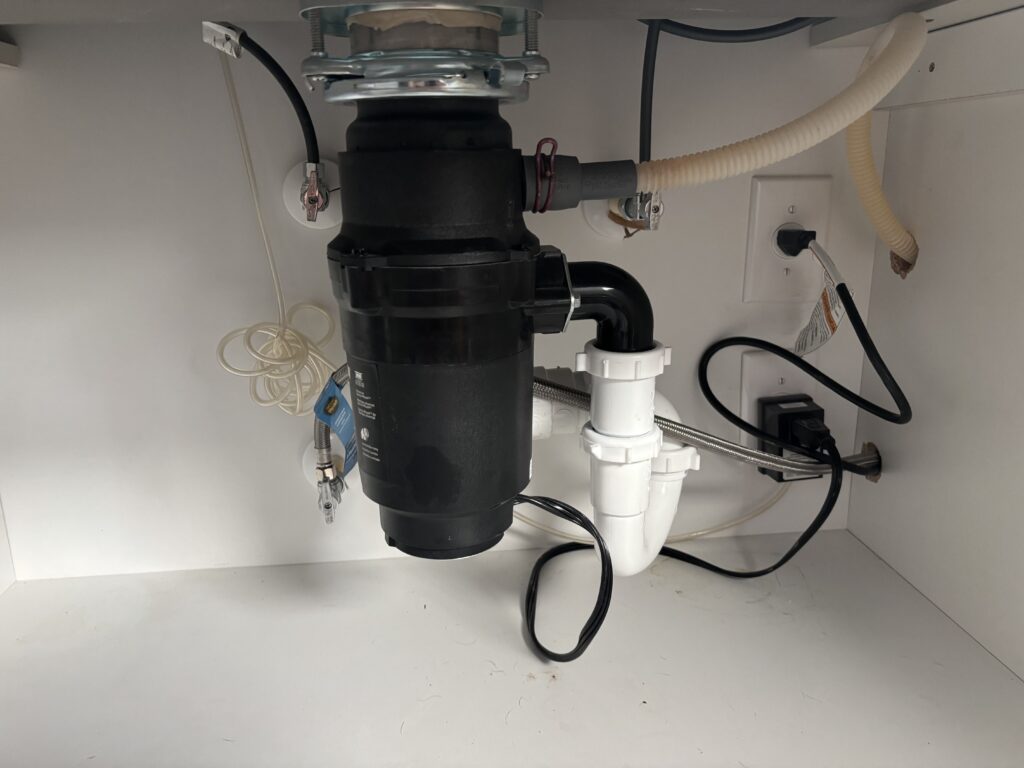
A thorough cleaning removes the film that causes odors and slows grinding, and it takes very little time. Start by shutting off power to the unit at the wall switch and, for extra safety, at the circuit breaker. Lift the rubber splash guard, sometimes called the baffle, and look at the underside with a flashlight. That surface collects a layer of grease and food residue that never gets ground up, and it is the most common source of a sour kitchen smell. Scrub it with an old toothbrush or a dish brush, warm water, and a small amount of liquid dish soap. Some splash guards pull out for easier cleaning, so check yours before forcing anything. Wipe the sink flange and the rim of the drain opening while you are there. Restore power only after your hands and tools are completely clear of the opening.
Once the splash guard is clean, scour the grinding chamber itself. Fill the chamber about halfway with ice cubes, add a tablespoon or two of rock salt, run cold water, and turn the unit on until the ice is gone. The ice and salt knock loose the residue clinging to the grind ring and impellers without damaging any components. A few small pieces of citrus peel afterward will help with lingering odor, though peels should be used sparingly rather than as a daily habit. Skip chemical drain cleaners entirely, since the caustic ingredients sit against metal parts and rubber seals and can shorten the life of the unit and the trap. Bleach is also a poor choice for the same reason and does nothing for buildup further down the line. If odors return within a day or two of cleaning, the problem is usually grease coating the drain pipe rather than anything inside the disposal. Sanitizing the chamber will not solve a pipe that is already lined with hardened fat.
Finish by flushing the drain line that carries everything away. Plug the basin, fill it with several inches of cold water, add a squirt of dish soap, then pull the stopper and run the disposal as the water drains. The volume of water pushes ground waste through the trap instead of letting it settle in the low spot of the pipe. Do not rely on hot water alone for this, because heat liquefies grease just long enough for it to travel a few feet and harden somewhere less convenient. If the sink still drains slowly after cleaning, the blockage is beyond what home methods can reach and needs professional equipment. Getting the line cleared before the holidays is far easier than dealing with a backed up kitchen sink on a Thursday afternoon with guests in the house. Sink still draining slow after cleaning? Click here for our drain cleaning service.
Garbage Disposal Warning Signs to Fix Before Holiday Cooking Starts
A humming motor with no grinding is the most common garbage disposal warning sign, and it means the flywheel is jammed. Shut the switch off right away, because power is still reaching a motor that cannot turn and heat builds fast. Most units have a hex socket on the underside center that accepts an offset wrench, which lets you rock the flywheel back and forth to free the obstruction. Many disposals also ship with that wrench taped to the housing or clipped nearby. After freeing the jam, press the red reset button on the bottom of the unit and try it again with cold water running. Never put your hand into the chamber, even after cutting power at the breaker. If the unit jams repeatedly after being cleared, something is worn or damaged inside and it will not survive a heavy holiday week. Repeat jamming is a replacement conversation, not a cleaning one.
Slow drainage, standing water, and returning odors point at the drain line more than the appliance. A kitchen line that has collected years of grease will have a smaller opening than the pipe diameter suggests, sometimes dramatically so. Gurgling from the second basin, water backing up when the dishwasher drains, and a smell that comes back within a day of cleaning all fit that pattern. Homes with original cast iron drains often have rough interior surfaces that grab grease and food particles more aggressively than modern PVC. A camera inspection can show exactly how much of the pipe is left open and where the restriction sits. That information tells you if a simple cabling will do or if the line needs to be scoured. Guessing here usually costs more than checking. Holiday volume turns a partial restriction into a full blockage very quickly.
Leaks and electrical problems deserve immediate attention. Run your hand along the top of the mounting assembly, the discharge tube, the dishwasher inlet, and the seam of the disposal body, then check the cabinet floor for water stains, swelling, or a musty smell. A leak at the sink flange usually means the plumber’s putty or mounting hardware has failed and can be resealed. A leak from the discharge tube often needs a new gasket or a properly aligned connection. Water coming from the body itself means the internal shell has cracked or corroded, and that unit needs to be replaced rather than repaired. Frequent trips to the reset button, a breaker that keeps tripping, or a burning smell all point to a motor near the end of its life. Most residential disposals last roughly eight to fifteen years depending on use and quality. If yours is in that range and acting up, replacing it before the holidays is the safer choice.
What Not to Put in Your Garbage Disposal During Holiday Cooking
Knowing what to keep out of your garbage disposal during holiday cooking prevents more clogs than any cleaning routine. A disposal grinds food into small particles; it does not dissolve them, and it has no effect on the pipe once the waste leaves the chamber. Everything that goes in still has to travel through a trap, a branch line, and eventually the main drain. Some foods harden, some swell, and some wrap around the impellers and stop the motor cold. Holiday menus are full of the worst offenders, which is exactly why plumbers see so many kitchen backups in late November and December. The problem is rarely one bad item; it is volume, speed, and grease all arriving together while several people work in the same kitchen. Setting out a scrap bowl and telling guests what stays out of the sink solves most of it. The lists below cover the items that cause the most damage and what to do with them instead.
Grease and Oil Are the Worst Things for a Garbage Disposal During Holiday Cooking
Grease is liquid in the pan and solid in the pipe, and that single fact explains most kitchen drain failures. Hot fat pours easily and seems harmless going down, then cools within a few feet of the sink and clings to the pipe wall. Each pour adds another layer, narrowing the opening the way plaque narrows an artery. Ground food particles stick to that coating instead of washing through, and soap residue binds the whole mass together. Over months and years, the line can close almost completely while the sink still appears to drain acceptably. Then a heavy holiday load arrives and the remaining opening seals shut. Cold water helps by keeping fats firm enough to move as particles, but it is not a license to pour grease down the drain. No amount of water makes fat a good thing to send into a pipe.
Holiday cooking produces far more grease than a typical week, and much of it is easy to overlook. Turkey drippings, gravy, pan fat from roasts, butter, bacon grease, oil from frying, cream sauces, cheese, salad dressing, and marinades all count. Rinsing a roasting pan sends a startling amount of fat into the drain in a matter of seconds. So does scraping plates coated in gravy, or dumping the last of a cheese dish into the sink. Dairy is often forgotten because it does not look like grease, but butterfat behaves the same way once it cools. The dishwasher makes it worse in one specific way: it drains through the same line and adds warm, greasy water on top of everything else. A single holiday meal can move more fat through a kitchen line than an entire ordinary month.
Handling grease correctly is simple and costs nothing. Pour cooled fat into a can, jar, or lined container, let it solidify, and put it in the trash. Wipe greasy pans and plates with a paper towel before they ever reach the sink. Scrape solid scraps into a trash can or compost bin rather than pushing them into the drain. Keep a mesh strainer in the basin so small particles get caught instead of accumulating in the trap. If your kitchen line already drains slowly and smells sour, hardened grease is almost certainly the cause, and a cable alone will only punch a hole through it. High pressure water scouring removes the buildup from the full circumference of the pipe and restores the original diameter. Dealing with years of grease buildup in your kitchen line? Click here for our hydro jetting service.
Starchy Foods That Clog a Garbage Disposal During Holiday Cooking
Starchy foods behave very differently from other scraps once they hit water and a spinning grind ring. Potato peels are the classic example, and they show up by the bagful during holiday cooking. Ground peels turn into a thick paste that coats the impellers and the walls of the chamber instead of flushing away. Rice and pasta continue absorbing water after they are ground, expanding inside the trap where there is nowhere for them to go. Stuffing, bread, and mashed potato leftovers do much the same thing, forming a dense plug that water cannot push through. Oatmeal and flour based batters belong in the same category. None of these items are dangerous to the motor, but they are extremely effective at blocking a drain.
The trouble multiplies when starch meets grease, which is exactly what happens on a holiday menu. Starch paste sticks readily to a greasy pipe wall and gives the next round of food particles something to grab. The result is a solid mass in the low point of the trap or the horizontal run of the branch line. That mass rarely announces itself right away; the sink drains a little slower, then a little slower, and then not at all. By the time water is standing in the basin, the blockage may be several feet long. Chemical drain products struggle against this kind of clog and can leave caustic liquid sitting in a sink you now have to work around. Mechanical clearing is the reliable fix.
Managing starchy waste takes only a small change in habit. Peel potatoes and vegetables over a trash can, a compost bin, or a bowl instead of over the sink. If some peels do end up in the disposal, feed them a few at a time with cold water running hard, never as a full colander at once. Do the same with leftover rice, pasta, and stuffing, and consider putting most of it in the trash instead. Run cold water for a solid thirty seconds after grinding starchy waste so the particles clear the trap completely. Ask anyone helping in the kitchen to follow the same rule, since most clogs come from someone who did not know the house policy. A scrap bowl next to the sink makes the right choice the easy choice.
Fibrous Scraps and Hard Items That Jam a Garbage Disposal During Holiday Cooking
Fibrous foods are the items most likely to stop a garbage disposal outright. Celery stalks, corn husks, onion skins, artichoke leaves, asparagus ends, rhubarb, banana peels, and pumpkin pulp all contain long stringy fibers. Those fibers do not shred; they wrap around the flywheel and impellers like thread around a spindle. Once wrapped, they bind the mechanism, the motor hums, and the unit trips its overload protection. Even when the unit keeps running, the strings tend to escape into the trap and form a net that catches everything else. Holiday prep involves large quantities of exactly these vegetables. The trash can is the correct destination for all of them.
Hard objects cause the other half of the jam problems and can do permanent damage. Bones, poultry joints, fruit pits from peaches or avocados, shellfish shells, nut shells, and corn cobs are all harder than the food a residential unit is designed to process. They chip impellers, dull the grind ring, and can crack the housing under repeated impact. Non food items are just as common in a busy kitchen, including produce stickers, twist ties, bottle caps, rubber bands, and the occasional piece of silverware. Coffee grounds and eggshells deserve a mention as well; they grind easily but settle as fine sediment in the trap where they build up over time. If something hard falls into the chamber, cut the power and remove it with tongs or long pliers rather than trying to grind it. A minute of retrieval prevents an expensive repair.
The practical challenge during the holidays is that other people are using your sink. Guests scraping plates have no idea what your disposal can handle or how your drain line has aged. Set a bowl or a lined trash can right next to the sink and mention what should stay out of it. If your unit is a batch feed model with a cover control, use the lid every time, since it also prevents objects from falling in. Keep the splash guard in place on continuous feed models for the same reason. Feed food gradually with cold water running, and give the unit a moment to clear between handfuls. These small habits carry a disposal through the busiest cooking days of the year without a single stall.
Why You Need a Professional Garbage Disposal Check Before the Holidays
A professional check before the holidays turns an unpredictable appliance into a known quantity. A licensed plumber can tell in a short visit if your disposal has years left or is on borrowed time, and can tell if the drain line behind it is genuinely clear. That matters because most holiday kitchen emergencies are not really disposal failures; they are drain failures that a struggling disposal made obvious. Scheduling in advance also means you pick the appointment time instead of calling for emergency service in the middle of a family dinner. Repairs and replacements are far less disruptive when the kitchen is not full of food and people. The sections below cover what a service visit accomplishes, when replacement makes better sense than another repair, and why local homeowners around Pittsburgh call Overbrook Plumbing for this work.
Why a Garbage Disposal Repair Call Before the Holidays Saves Money
Timing is the biggest factor in what a plumbing problem ends up costing you. A clog found in October is a scheduled appointment on a normal weekday; the same clog on a holiday evening is an urgent call with a kitchen full of people waiting. Booking ahead lets you choose a time that fits your schedule and keeps the work out of your cooking days. It also gives you room to consider options, get questions answered, and make a decision without pressure. Small problems stay small when they are addressed early, and a slow drain almost never gets better on its own. A short visit now often prevents a much larger job later.
A proper service visit looks at the whole system, not just the appliance. A plumber will check the mounting assembly and flange seal, inspect the discharge tube and dishwasher connection, test the motor for signs of strain, and confirm the electrical connection and reset function work as they should. The P trap gets checked for buildup, and the branch line gets evaluated for flow. When a sink has clogged more than once, a camera inspection shows the actual condition of the pipe interior and where the restriction sits. That evidence takes the guesswork out of the recommendation. You end up paying for the repair you actually need rather than a series of temporary fixes.
The cost comparison usually settles the question quickly. Clearing a kitchen line or repairing a disposal is a modest, predictable expense. A backup that overflows a sink, or a leak that soaks a cabinet floor and subfloor, brings in water damage, ruined cabinetry, and the possibility of mold. Damage under a sink often goes unnoticed for weeks because the cabinet stays closed most of the time. Preventive work protects the appliance, the plumbing, and the kitchen around it. Spending a little in the fall is far easier than spending a lot in December.
When Garbage Disposal Replacement Beats Another Holiday Season of Repairs
There comes a point where replacing a garbage disposal makes clear financial sense. Water leaking from the body of the unit is the clearest signal, since a cracked or corroded shell cannot be repaired. Frequent trips to the reset button, a breaker that keeps tripping, a burning smell, or a motor that bogs down under light loads all point to internal wear. Chronic jams after clearing usually mean the grind components are damaged. Most residential units run eight to fifteen years, and a disposal near the top of that range with symptoms is not worth another round of repairs. Going into the busiest cooking season with a failing unit is asking for trouble.
Replacement is also a chance to fix a sizing problem you may not know you have. Many homes have builder grade units in the one third horsepower range, which struggle with the volume a holiday kitchen produces. Stepping up to one half or three quarters horsepower gives you faster grinding, less strain on the motor, and fewer stalls when scraps go in quickly. Better units use stainless steel grind components that resist corrosion and hold their edge longer. Sound insulation on higher models makes a noticeable difference in an open kitchen. Manufacturer warranties on quality units are longer as well, which matters over a decade of use.
Correct installation is what makes a new unit perform the way it should. The sink flange has to be sealed properly so the mounting assembly does not weep into the cabinet, and the discharge tube has to line up with the trap without stress on the connection. On homes with a dishwasher, the knockout plug in the disposal inlet must be removed before the hose is attached, or the dishwasher will not drain at all. Electrical connections need to be secure and correctly grounded, and the whole assembly should be tested under real flow before the job is called finished. Those details are easy to get wrong and expensive to discover after the fact. Ready for a disposal that can handle a full holiday kitchen? Click here for our garbage disposal installation service.
Why Choose Overbrook Plumbing for Garbage Disposal Service Before the Holidays
Overbrook Plumbing is a local, Pittsburgh based plumbing team, and we work in these neighborhoods every day. We know the housing stock here, including the older homes with cast iron and galvanized drain lines that need a different approach than newer construction. Every job is performed by a licensed and insured plumbing team in Pennsylvania, and we stand behind the work we do. Our pricing is honest and straightforward, so you know what the job costs before we start. There are no surprise line items added after the fact. We would rather earn a customer for years than win a single ticket.
We also know that plumbing problems ignore the calendar, which is why we offer 24/7 emergency plumbing services. A backed up kitchen sink on a holiday evening does not have to ruin the day. We offer military and senior discounts as a thank you to the people who have earned them. Customers who choose us for tankless water heaters receive a one year labor warranty on that work. Every visit is handled with the same goal, which is a 5 star service experience from the first call to the final cleanup. That standard applies to a garbage disposal swap just as much as a major repair.
We serve homeowners throughout the Pittsburgh area, including Mount Lebanon, Bethel Park, Upper St Clair, Ross Township, Shaler Township, Baldwin, South Park, Penn Hills, Monroeville, Plum, McCandless, Hampton Township, Moon Township, West Mifflin, Cranberry Township, and the surrounding communities. Handling disposal service, drain cleaning, and line inspections before the holidays is the easiest way to keep your kitchen running when it matters most. Our team can look at the appliance, the trap, and the branch line in a single visit and tell you exactly where you stand. Call Overbrook Plumbing at (412) 736-4654 to schedule your garbage disposal check before holiday cooking begins, or email us at info@calloverbrook.com. You can also find us at 209 Richfield St, Pittsburgh, PA 15234, and we are ready to help whenever you need us.